
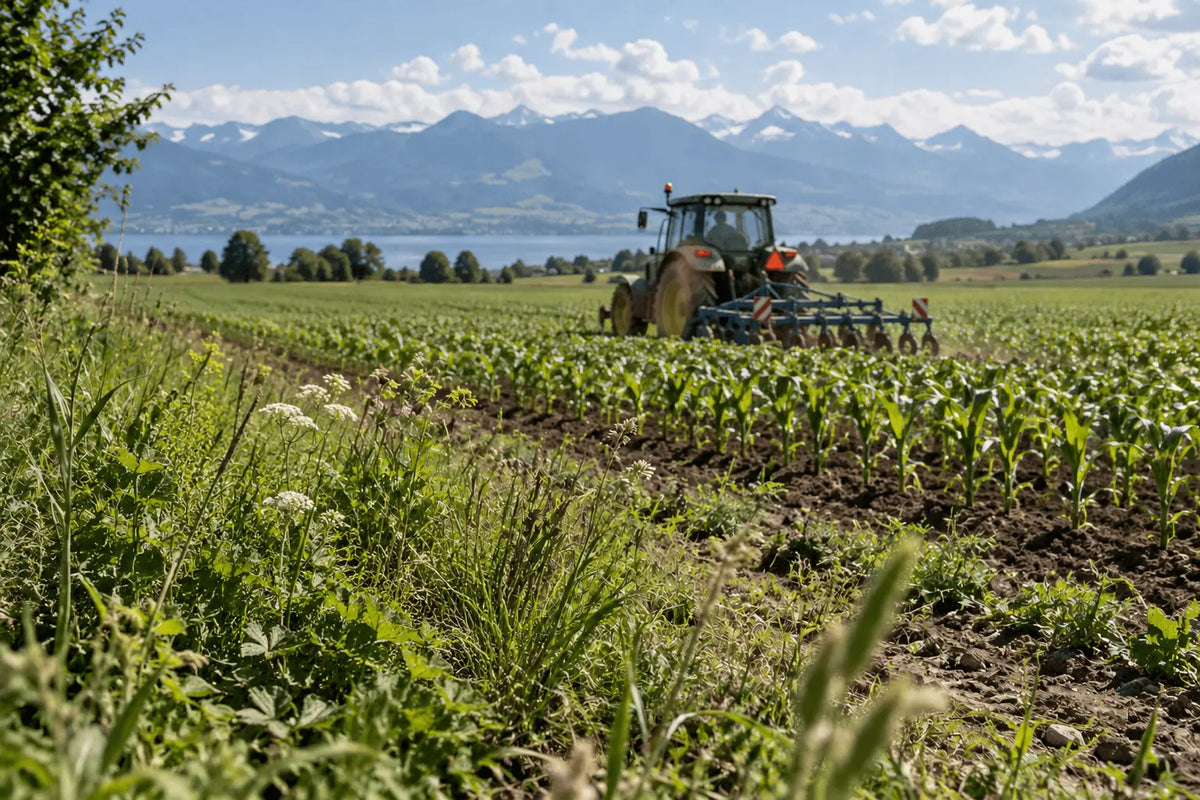
Chlorothalonil has been banned in Switzerland since 2020. Yet six years later, its breakdown products are still present in groundwater. The latest national data show in particular that one of its metabolites exceeds 0.1 µg/L at more than one in four monitoring stations in Switzerland.
What is chlorothalonil?
Chlorothalonil is a fungicide used for several decades in Swiss agriculture to protect various crops against certain diseases caused by fungi.
Its use has been banned in Switzerland since 2020. But withdrawing a product from the market does not mean its traces disappear from the environment straight away.
When chlorothalonil breaks down in soil, it forms several new molecules called metabolites. Some are very persistent and can gradually reach groundwater.
Why does this matter in Switzerland?
Around 80% of Swiss drinking water comes from groundwater. When a persistent substance reaches an aquifer, it can therefore remain measurable for many years in a resource used to produce drinking water.
R471811 and R417888: what is the difference?
The names R471811 and R417888 do not refer to two different pesticides. They are two different breakdown products of chlorothalonil.
However, they are not present in the same proportions in Swiss groundwater. R471811 is far more widespread, while R417888 exceeds the 0.1 µg/L value less often.
| Metabolite | Presence on the Swiss Plateau | Key point |
|---|---|---|
| R471811 | More than 50% of stations above 0.1 µg/L | The more widespread of the two |
| R417888 | Around 10% of stations above 0.1 µg/L | Less often present at high concentrations |
What the latest FOEN data show
In February 2026, the Federal Office for the Environment (FOEN) published the 2024 data from the National Groundwater Monitoring programme NAQUA.
In total, seven chlorothalonil metabolites were measured at concentrations above 0.1 µg/L in Swiss groundwater.
The two metabolites most visible on a large scale are precisely R471811 and R417888.
Two maps to understand the difference
The following two maps show the same types of monitoring station, but not the same molecule.
The first shows R471811, which is widespread in the farming regions of the Plateau. The second shows R417888, for which concentrations above 0.1 µg/L are much less frequent.


Swipe to compare the two metabolites →
How to read the maps
The dots represent groundwater monitoring stations. Red dots indicate concentrations above 0.1 µg/L. The shaded areas show the proportion of cereal crops. These maps therefore do not directly represent the quality of the water at each tap.
0.1 µg/L: is it a danger threshold?
This is where the issue becomes more complex.
The value of 0.1 µg/L applies to plant protection product metabolites considered relevant for drinking water.
But in March 2026, the Federal Administrative Court ruled that several chlorothalonil metabolites should remain classified as non-relevant, including precisely R471811 and R417888.
According to the Court, the mere fact that these two metabolites exceed 0.1 µg/L is therefore not enough, on its own, to demonstrate a health risk to humans or to justify banning the plant protection product.
Presence does not necessarily mean danger
R471811 and R417888 are indeed measured in groundwater, sometimes at concentrations above 0.1 µg/L. But the data available in 2026 do not allow them to be presented simply as an established health hazard for humans.
So why does chlorothalonil remain banned?
Because the case does not concern R471811 and R417888 alone.
In its judgment of 26 March 2026, the Federal Administrative Court confirmed that withdrawing the authorisation of a product containing chlorothalonil was lawful.
One of the main reasons is environmental: assessments carried out at European level concluded that the use of chlorothalonil posed a high risk to amphibians and fish.
A clearly identified ecological risk
The Federal Administrative Court points out that the European assessment identified a high risk to fish and amphibians, such as frogs and newts, from the use of chlorothalonil. This finding alone is enough to justify withdrawing the authorisation.
It is important not to jump to conclusions: this does not mean that R471811 and R417888 themselves were identified as responsible for this ecological risk to the same extent.
The Court specifically distinguishes between the different metabolites. The environmental risk concerns the use of chlorothalonil and its assessment as a whole, while the question of the human toxicity of R471811 and R417888 is dealt with separately.
Other chlorothalonil metabolites considered relevant have also occasionally been found above 0.1 µg/L in groundwater. The Court therefore also upheld the withdrawal of the product on grounds relating to the protection of groundwater and drinking water.
Why is there still talk of “non-compliant” water?
The regulatory situation remains unusual in 2026.
The Federal Food Safety and Veterinary Office (FSVO) still maintains a directive on the measures to be taken when the maximum values applicable to chlorothalonil metabolites in drinking water are exceeded. This directive was updated again on 21 May 2026.
In other words, the Court’s judgment does not automatically remove the rules applied to water suppliers. The legal and technical consequences of the decision still have to be incorporated by the competent authorities.
The current debate is therefore not about whether the metabolites exist: their presence in aquifers is thoroughly measured. It is mainly about how some of them should be classified and regulated.
Why are these substances still present six years later?
Groundwater renews itself slowly. Several years can pass between the moment a substance reaches the soil and the moment its breakdown products reach an aquifer.
Chlorothalonil metabolites are also particularly persistent. The FOEN therefore expects them to continue affecting groundwater quality for several more years.
A trend now heading downwards
According to the latest FOEN data, concentrations of chlorothalonil metabolites are now falling. The effect of the ban is therefore beginning to show, even though aquifer pollution cannot disappear quickly.
The problem goes beyond chlorothalonil
Chlorothalonil is particularly visible in the current data, but it is not the only plant protection product whose metabolites are present in Swiss groundwater.
According to the FOEN, 24 metabolites from 12 different active substances currently exceed the 0.1 µg/L value.
In arable farming areas, chlorothalonil metabolites exceed 0.1 µg/L at around 70% of monitoring stations.
Groundwater and tap water: mind the difference
The NAQUA maps show groundwater. They cannot be used to determine directly the quality of the water coming out of the tap in a home.
A supplier may operate several catchments, blend different sources or treat the water before distributing it. The situation can therefore vary greatly from one municipality to the next.
Is your region shown in red?
That does not automatically mean that your tap water exceeds a regulatory value. To find out the exact situation, check the analyses published by your water supplier or by the relevant cantonal authority.
Key takeaways
- Chlorothalonil has been banned in Switzerland since 2020.
- The withdrawal of its authorisation was upheld by the Federal Administrative Court in March 2026.
- R471811 and R417888 are two different metabolites of chlorothalonil.
- R471811 exceeds 0.1 µg/L at more than 50% of Plateau stations and at more than one station in four nationwide.
- R417888 exceeds 0.1 µg/L at around 10% of Plateau stations.
- The Federal Administrative Court considers R471811 and R417888 to be metabolites that are not relevant in terms of human toxicology.
- Their presence above 0.1 µg/L therefore does not, on its own, justify concluding that there is a health hazard for humans.
- The use of chlorothalonil nevertheless remains banned, in particular because of a high risk identified for fish and amphibians.
- Other chlorothalonil metabolites considered relevant have also been detected in groundwater.
- Concentrations have been falling since the ban, but their persistence means they will remain measurable for several more years.
Official data
NAQUA National Groundwater Monitoring 2024
Sources: Federal Office for the Environment (FOEN), NAQUA National Groundwater Monitoring 2024 · Federal Administrative Court, judgment B-531/2020 of 26 March 2026 · Federal Food Safety and Veterinary Office (FSVO), directive 2024/1, updated on 21 May 2026.